MEMORIAL DAY SALE
50% off* select plans for a year
Save big and let us handle covered home hassles.

Save big and let us handle covered home hassles.

Air conditioning accounts for about 19% of electricity use in U.S. homes, according to the U.S. Energy Information Administration, and with good reason. When temperatures climb, the question isn't whether to run the AC, it's which system makes sense for your home. Understanding the differences between central and window air conditioning is the first step to making the right call. This guide breaks down how each system works, what it costs, and how to figure out which choice is right for you.
Learn more about AHS air conditioner coverage and how a home warranty can help protect your system.

In this article:
When you compare central air conditioning and window units, the core difference comes down to scope. A window unit cools one room. A central air system cools your entire home. Everything else, like cost, efficiency, installation, noise, flows from that distinction.
A window air conditioner is a self-contained unit that mounts in a standard window frame. It pulls warm room air over refrigerant coils, cools it, and circulates it back—all in a single compact unit. Installation is a DIY-friendly process that most homeowners can handle in under an hour.
Apartments, renters, small homes, or homeowners who only need to cool one or two rooms. Also works well as a supplement to central air for a space the ductwork doesn't reach, like a garage, sunroom, or addition.
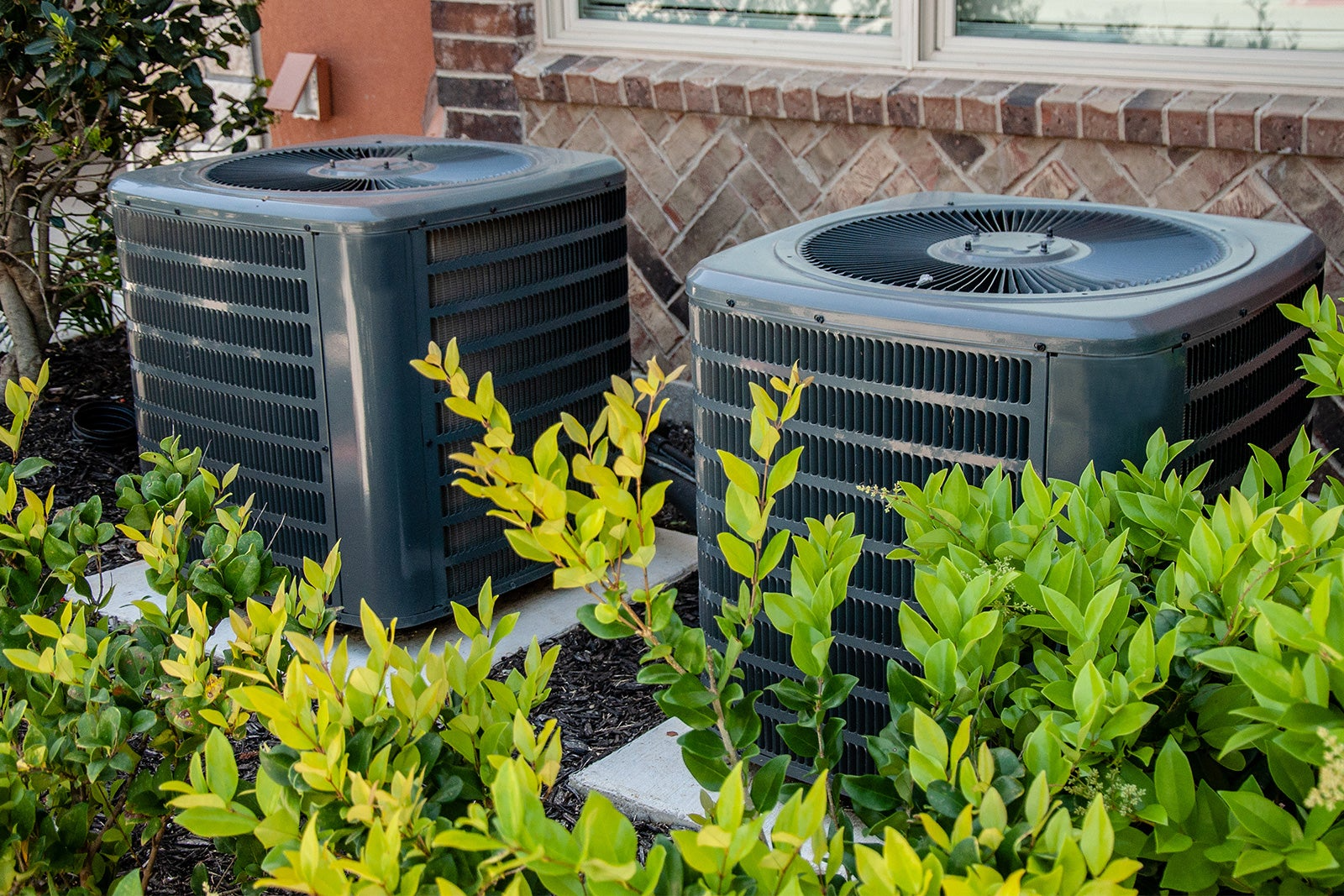
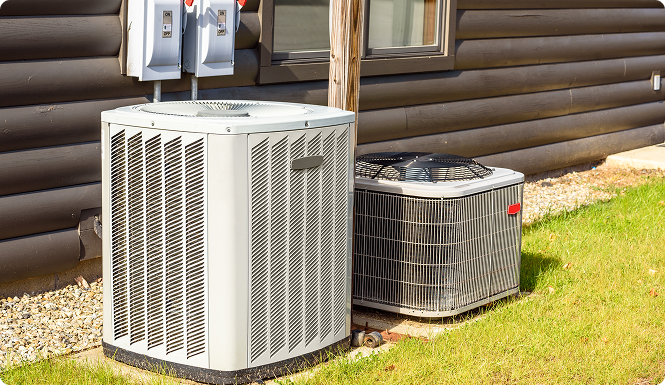
Central air conditioning uses an outdoor condenser unit connected to an indoor air handler, distributing cooled air throughout your home via a duct and vent system. A single thermostat controls the whole house, making it easy to maintain consistent temperatures room to room.
According to the U.S. Energy Information Administration, two-thirds of U.S. households use central AC or a central heat pump as their primary cooling equipment.
Homeowners with existing ductwork who want consistent whole-home comfort, or those making a long-term investment in a property they plan to keep.
Not quite. If neither option fits your situation, a ductless mini-split is worth a close look.
A ductless mini-split connects an outdoor compressor to one or more indoor air handlers through small refrigerant lines, with no ductwork required. Each indoor unit controls the temperature in its zone independently, giving you room-by-room flexibility without the footprint of a window unit. Learn more in our guide to mini-split AC systems.
Homes without existing ductwork, room additions, historic properties where ductwork isn't feasible, or homeowners who want zoned efficiency without a full central system.
Central air conditioners are generally more efficient than room air conditioners for cooling multiple rooms.4 But for smaller spaces or targeted cooling needs, a window unit or single-zone mini-split may be more practical. Sprawling layouts with multiple floors or additions can complicate ductwork runs and make a hybrid or zoned approach worth considering. For more on choosing the right AC unit for your home, see our full guide.
If you spend most of your time in one or two rooms, you don't need to cool the whole house. A window unit or mini-split handles targeted cooling efficiently. If you move freely throughout the day, central air delivers more seamless and consistent comfort.
Window units win on upfront cost. But running four or five units to cool an average-size home can cost more over time than a single properly sized central air system. According to EIA data, homes using central air spend about twice as much on cooling in total, but central air costs roughly half as much per square foot as individual units. Factor in both installation and operating costs, not just the sticker price.
A single window AC unit draws roughly 500 to 1,500 watts5, while central AC systems typically use more than 3,500 watts. However, when multiple window units run simultaneously, that efficiency advantage disappears fast. Central air becomes more cost-efficient per square foot as home size increases. Understanding how air conditioning works can help you make a more informed decision on sizing and efficiency.
Window units are louder, especially at startup. Central air keeps the compressor outside, resulting in quieter indoor operation that's especially noticeable in bedrooms. Mini-splits land somewhere in between, with low-profile indoor units that run quietly.
Renters generally can't install central air. Homes without existing ductwork face a substantial added cost. If you're renting, live in a condo, or have a space where ductwork isn't practical, a window unit or ductless mini-split is likely your most realistic path. If you're a homeowner planning to stay long-term, it's worth understanding what goes into buying a new AC unit before committing.
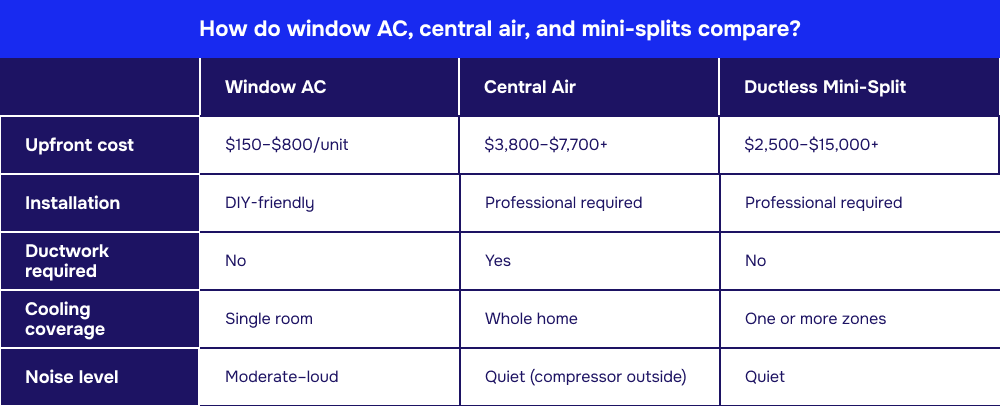
The answer depends on your home, your habits, and your budget. If you're a renter or need to cool one room quickly without a big investment, a window unit does the job. If you own a larger home and want consistent comfort with long-term value, central air is the stronger investment. If you're somewhere in between, with no ductwork, specific zones to control, or spaces your central system can't reach, a ductless mini-split bridges the gap.
Window unit or central system, American Home Shield® has a home warranty plan built for your home.
If you rely on central air or a ductless mini-split to keep your home comfortable, protecting that investment makes sense. All three American Home Shield home warranty plans—ShieldSilver, ShieldGold, and ShieldPlatinum—include coverage for central air, ductless mini-splits, and wall AC units, up to $5,000 per system per agreement term. See what's included in AHS home system coverage.
Note that window AC units are not covered under AHS plans. If you're relying on window units now but considering a longer-term cooling solution, you may want to factor warranty coverage into that decision.
Should a covered system need replacing rather than repairing, the AHS New HVAC Program to replace or upgrade your current cooling and heating systems helps take the sting out of the cost.
Ready for a breath of fresh air? The New HVAC Program makes it easier than ever for AHS members to upgrade their system.

AHS assumes no responsibility, and specifically disclaims all liability, for your use of any and all information contained herein.
Sources:
1https://homeguide.com/costs/ductless-mini-split-ac-cost
2https://homeguide.com/costs/hvac-cost
3https://homeguide.com/costs/ductless-mini-split-ac-cost
4https://www.energy.gov/energysaver/central-air-conditioning
5https://homeguide.com/costs/cost-to-run-an-air-conditioner
It depends on what you're cooling and how. Window AC units are better for cooling a single room efficiently and affordably, and they cost less upfront and use less electricity per unit. Central air is better for whole-home comfort, air quality, and long-term value. If your goal is to cool multiple rooms consistently, central air is typically the more practical and cost-efficient solution. For a single room or a small apartment, a window unit can get the job done.
The main drawbacks are coverage limitations, noise, and aesthetics. A single window unit can only cool the room it's in, so whole-home coverage requires multiple units, which raises both cost and energy use. Window units are louder than central systems, block natural light and window views, and may be restricted by landlords, HOAs, or local codes. They also need to be removed and stored during colder months to avoid damage and heating inefficiency. On first-floor windows, they can also present a security concern if not properly secured.
For a single room, a window unit is cheaper to run. But for whole-home cooling, central air typically wins on operating cost. According to EIA data, homes using central AC spend about twice as much on cooling in total. But because central air covers the entire home, the cost per square foot is roughly half that of individual units. If you're running four or five window units simultaneously, you're likely spending more on electricity than a properly sized central air system would require.
A single window AC unit uses far less electricity than a central air system: roughly 500 to 1,440 watts versus 3,500+ watts for central AC. However, that comparison only holds when you're cooling one room. Once you're running multiple window units, the combined wattage can easily exceed what a central system draws. For single-room or small-space cooling, window units are more energy efficient. For cooling most or all of a home, central air is the more efficient option per square foot cooled.