LIMITED TIME ONLY
Get 50% off* select plans
Save big and let us handle covered home hassles.

Save big and let us handle covered home hassles.

Homeownership is not for the faint of heart, especially for first-time homeowners, who might be facing problems they used to relegate to landlords. Whether it’s repairing appliances, checking the roof, dealing with radon, or even dreaded mold mitigation, homes demand a lot of time and attention to keep them in tip-top shape.
We wanted to know both how homeowners felt about their experiences with repairs, as well as understand the problems and repairs each state is most concerned about.
In late November 2025, we surveyed 1,006 homeowners about their experiences with home repairs. 50% were men, 50% were women, and ages ranged from 20 to 78 with an average age of 47.
To determine the biggest DIY stressor in every state, we analyzed 5,977 terms that focused on common home issues (wrong wiring, unclog sewage drain, signs of house foundation problems, etc), looking at relative search volume compared to the U.S. average over the course of November 1, 2024-October 31, 2025. From this we identified major themes in each state.
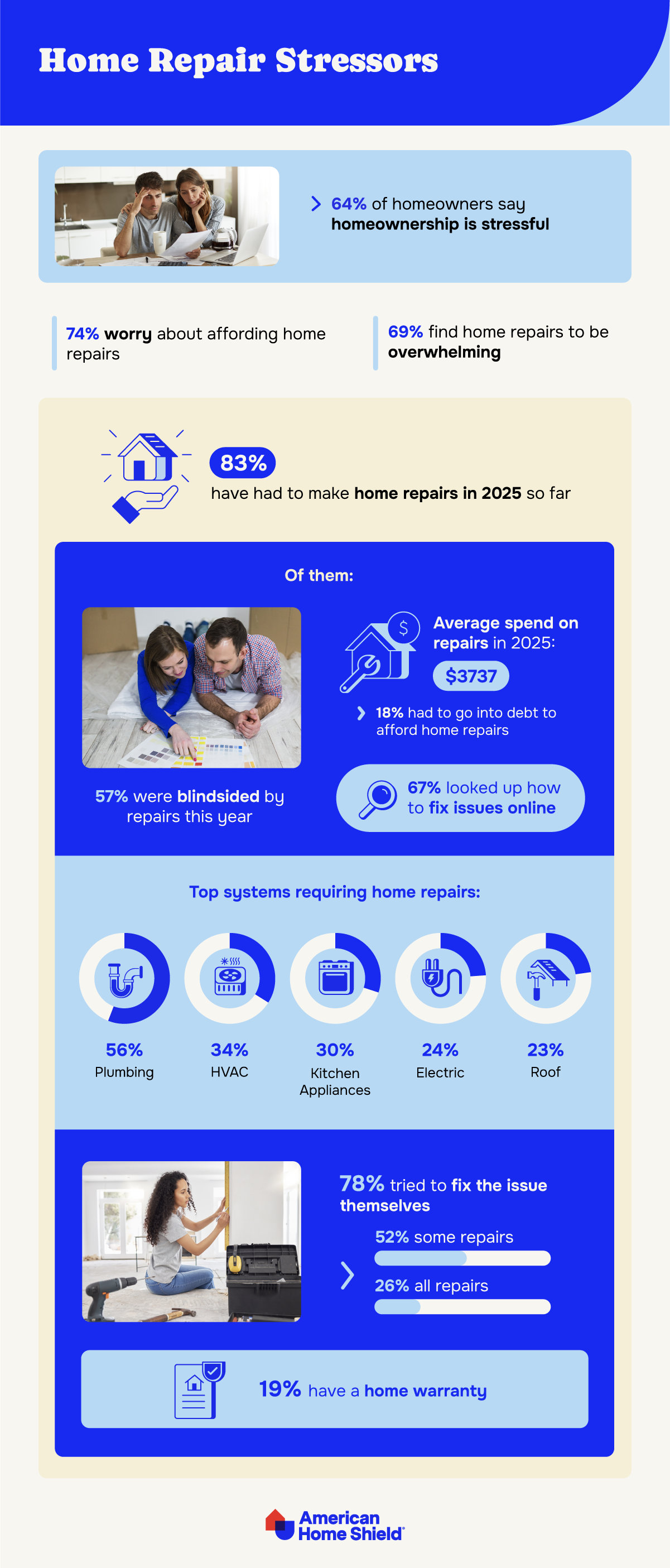
The home might be your castle, but this castle demands a lot of repairs. 64% of the homeowners we surveyed say that homeownership is stressful, and a full 74% worry specifically about affording home repairs. Another 69% say that home repairs are “overwhelming” them– and the numbers back that up.
83% of homeowners surveyed have had to make a home repair in 2025, and of them, 57% were “blindsided” by their repairs– unexpected surprises that can’t be planned for. This adds up: in 2025, homeowners spent an average of $3,737 on home repairs, and 18% of them had to go into debt to afford their repairs.
To save money, 78% embraced DIY, with 67% looking up how to fix issues online.
One thing that helped some? Having a home warranty. Roughly 1 in 5 (19%) reported having one and using it to address repairs.
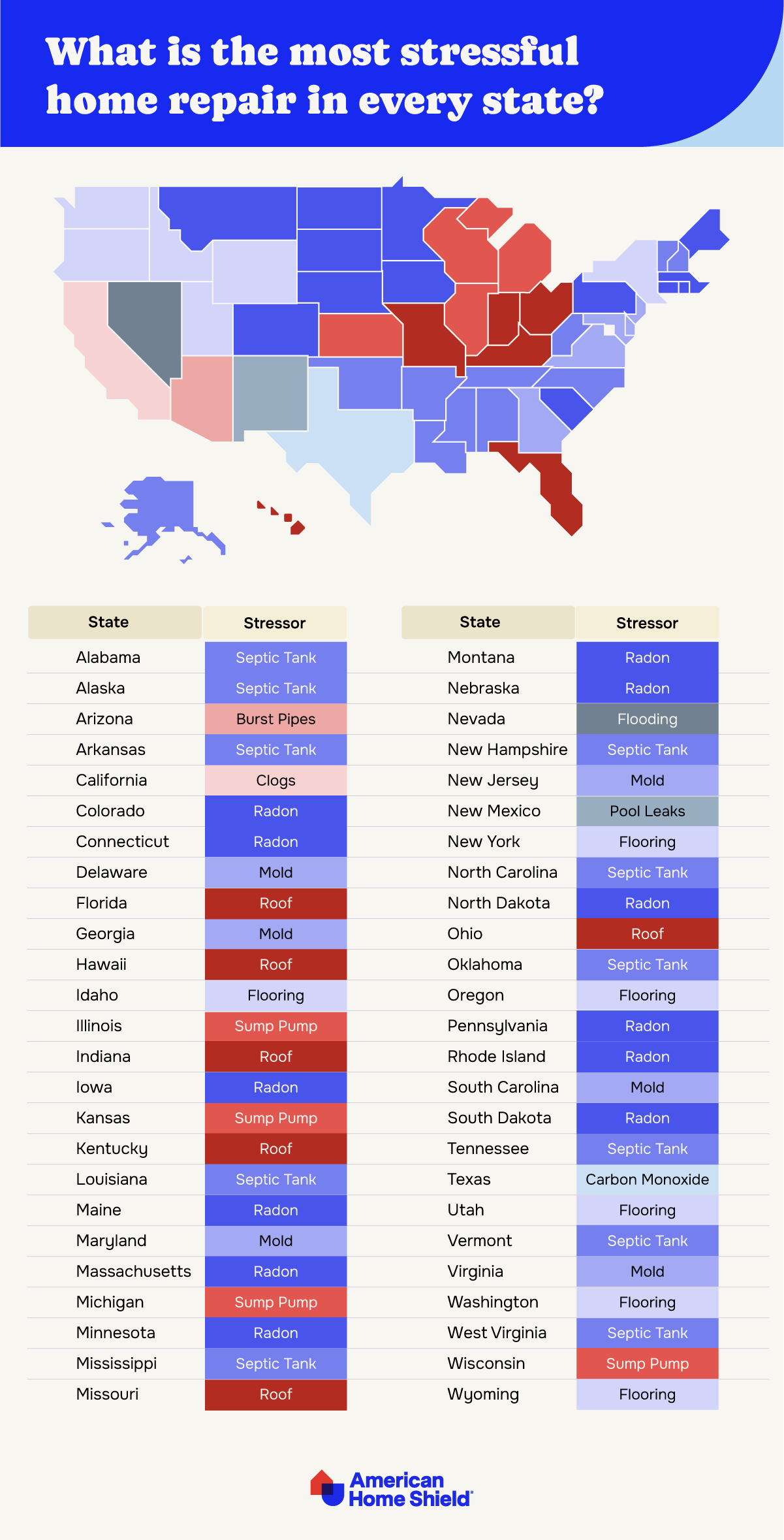
There’s a specter haunting the U.S., and its name is radon. 12 states in the nation listed Radon as their biggest stressor, including Colorado, Connecticut, Iowa, Maine, Massachusetts, Minnesota, Montana, Nebraska, North and South Dakota, Pennsylvania, and Rhode Island. Radon is a silent, radioactive gas shown to elevate risk of lung cancer over time; it often leaks into homes from the soil.
"Radon doesn’t announce itself with a smell or a warning sign, which is why public health experts urge homeowners to test regularly, every 2 - 5 years and address elevated levels before long-term exposure becomes a risk"
Roy Neely, AHS Expert
You can test for radon in your home by purchasing a test at your local hardware store that will measure radon levels. View our guide to go deeper on how to test for radon in your home.
Another major homeowner headache is septic tank issues. No one wants to think about their sewage, but septic tanks seem to make themselves known at the least opportune moments; 9 states, including Alabama, Alaska, Arkansas, Louisiana, Mississippi, New Hampshire, North Carolina, Vermont, and West Virginia, are stressing the most about septic tanks.
Sometimes the issue is beneath your feet: six states are stressed about flooring, whether it’s installing new flooring or resolving cracks in tile or even bad carpet. Idaho, New York, Oregon, Utah, Washington, and Wyoming are all stressing about floor issues and the prospect of DIY.
Mold is another major problem for six states, including Georgia, Delaware, Maryland, New Jersey, South Carolina, and Virginia. Some of these are highly susceptible to mold; others simply don’t like seeing black mold creep up the walls.
Other top issues include roof problems for states like Florida, Carbon Monoxide (the biggest problem in the U.S.! and big states like Texas), sump pumps (the scourge of the midwest region), pool leaks, flooding, clogs, and burst pipes.
With all the potential things that can go wrong in a home, it’s no shock that so many homeowners find it stressful. Happily, there are some things that definitely help at least manage stress, if not keep you cool, calm, and collected in the hardware store:
One of the best ways to keep repairs cheap is to do them yourself– but you need to know what you’re doing. While poorly done repairs can make things worse in the long run, taking time to learn basic electrical, plumbing, and HVAC maintenance can make most home problems feel much more manageable.
Sometimes everything happens at once, but that doesn’t mean you need to tackle everything at once also. We recommend developing a priority list, from the most pressing and necessary (it’s not good if your fridge doesn’t work) to the more optional (painting that dresser can wait for an easier time). This helps you prioritize your budget and time more wisely.
Much like death and taxes, home repairs are inevitable. While your house might be an investment, it does still remain subject to the laws of entropy– and putting aside a little extra money as a “just in case” can make your choices feel easier down the line.
Decrease the likelihood of future failure with a robust maintenance routine for your key appliances and home systems. A little proactive service will go a long way to giving them a long, productive, functional life.
Even if your home warranty doesn’t cover one of the above stressors, at AHS we can still help: our video chat feature has a team of live repair Experts to help troubleshoot or even fix your home hassles over the phone, including DIY projects, ensuring you're never alone in your projects and eliminating any feelings of homeownership overwhelm.
Whether it’s a leaking water heater to a non-heating oven, homeownership is no easy task– but having an AHS home warranty helps make it easier so you can enjoy your home to the fullest.
When using this data and research, please attribute by linking to this study and citing AHS.com.
For media inquiries, reach out to media@digitalthirdcoast.net
AHS assumes no responsibility, and specifically disclaims all liability, for your use of any and all information contained herein.