LIMITED TIME OFFER
Get 30% off* select plans
Enjoy special savings, and let us handle covered home hassles.

Enjoy special savings, and let us handle covered home hassles.

Once primarily used by businesses, security cameras have skyrocketed in popularity among U.S. homeowners, particularly since the advent of the Ring doorbell in 2014, which made smart home security both accessible and affordable.
Providing not only a sense of security, these cameras also enable homeowners to see what’s going on outside without opening their door, or even avoid interactions with salespeople in the process. On the other hand, some feel that doorbell cameras add just a little bit too much surveillance to a neighborhood, at the expense of relationships with neighbors.
We wanted to know why homeowners have invested so much in their home cameras– and whether crime in their neighborhoods was a motivating factor. To get to the bottom of the boom in cameras, we surveyed 1,001 homeowners in early September 2025, asking about their home security systems as well as their preferences around relying on neighbors to feel safe. 49% were women, 50% men, and 1% were either nonbinary or did not say; ages ranged from 20 to 75 with an average age of 47. In terms of location, 22% of respondents live in rural settings, 20% in urban settings, and 59% in the suburbs.
Security cameras have become a mainstay of modern home protection, with 78% of homeowners now owning some form of home security camera. Suburban residents lead in adoption at 82%, followed by 76% in urban areas and 69% in rural communities.
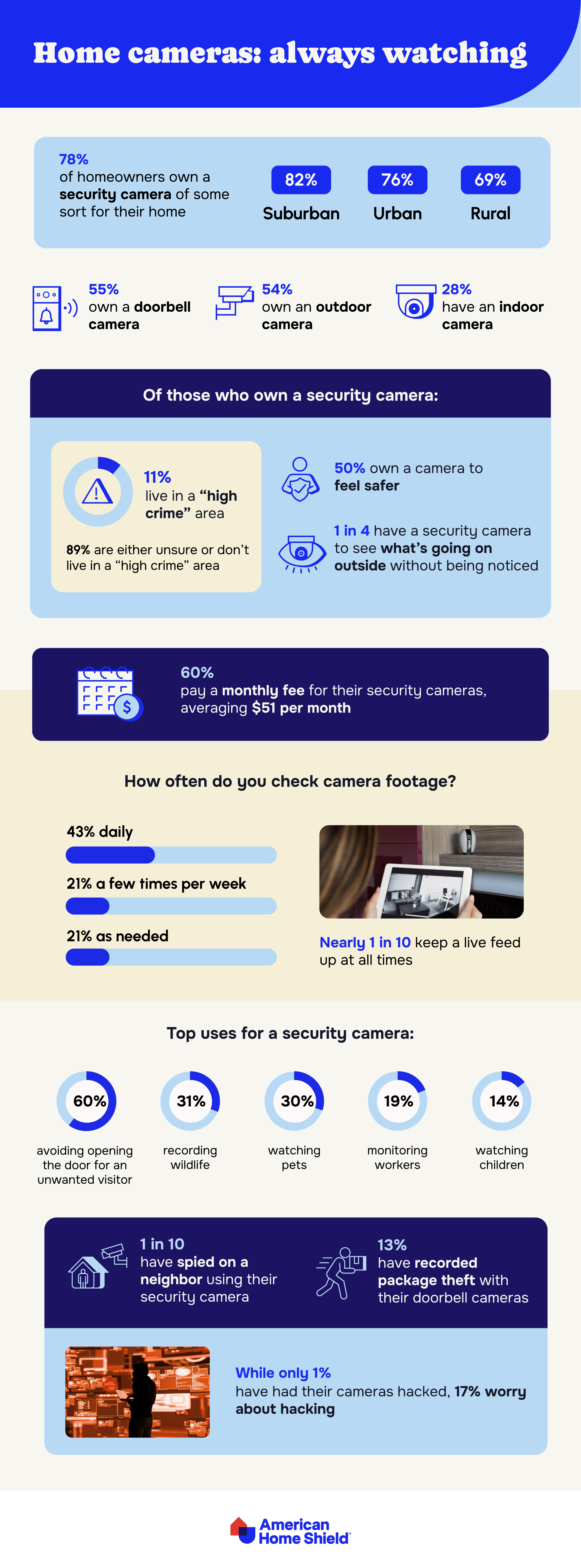
For many, these devices offer security and, perhaps more importantly, they soothe anxiety. Half of camera owners cite feeling safer as their primary reason for installing them. Yet, when asked, only 11% claimed to live in a “high crime” area where security cameras are a true necessity. 60% pay for camera systems, with an average monthly fee of $51.
Interestingly, homeowners are also highly engaged with their camera’s recordings: nearly 1 in 10 keep a live feed on their computers at all times, and nearly half – 43%-- check their footage daily. Another 1 in 5 check a few times per week.
The appeal goes beyond crime prevention: homeowners also use their cameras for more everyday purposes: 60% avoid answering the door for unwanted visitors, 31% enjoy recording wildlife, and 30% keep an eye on pets. 25% use them to discreetly monitor what’s happening outside without having to go outdoors, avoiding awkward interactions with passersby and neighbors; a smaller share monitors workers or watches children. Sometimes it’s for less noble purposes: 1 in 10 admit to using their camera to spy on neighbors.
Concerns about privacy are relatively low. Only 1% report having been hacked, although 17% do worry about it. Just 12% believe cameras should notify people when they're being recorded. And contrary to fears that surveillance might feel invasive, 90% of homeowners reject the idea that cameras are creepy. Nearly half believe these systems help deter crime.
We asked camera owners to share some of the wildest things they’ve seen, and they did not disappoint: respondents listed robberies, teenage children shimmying out of windows to go out unnoticed, wildlife, intimate relations between neighbors, and even “three raccoons fighting two squirrels!”
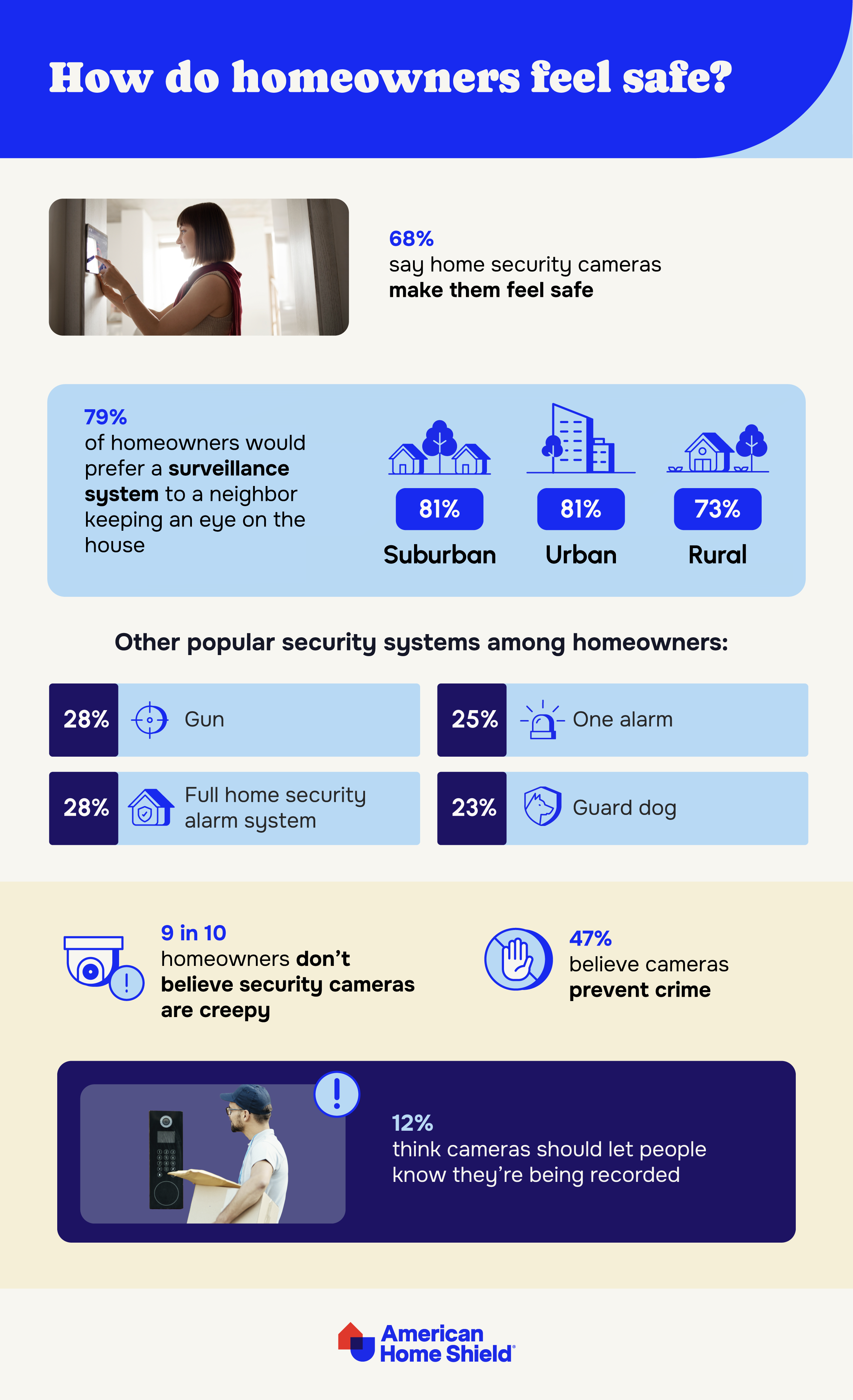
A majority of homeowners, 68%, say that security cameras make them feel safe and secure. When asked whether they prefer a camera system or a neighbor watching their house, 79% opt for technology. Urban and suburban residents are most comfortable with surveillance systems at 81%, while 73% of rural homeowners agree.
Other safety measures also remain popular. 28% of homeowners own guns, and a similar share have full home security alarm systems. One in four have at least one alarm in place, and 23% rely on a guard dog.
As surveillance technology becomes more commonplace, homeowners continue to embrace its benefits—from peace of mind and crime prevention to keeping tabs on the everyday rhythms of life at home.
Need help installing a camera system of your own? Consider an AHS home warranty for access to our video chat feature, where live repair Experts can help you assess and even help fix any of your home hassles and DIYs.
AHS assumes no responsibility, and specifically disclaims all liability, for your use of any and all information contained herein.